Hunter Articles
Dard Hunter: A Maker of Books
Papermaking by Hand in America
The Rare Book Market Today
Papermaking by Hand in America, A Masterpiece of Printing
Dard Hunter and Papermaking
Dard Hunter Books We Would Like To Have
Frank Weitenkampf. THE ETCHING OF CONTEMPORARY LIFE. Marlborough-on-Hudson, Dard Hunter, 1886
Dard Hunter: An Artist in the Making of Books
Dard Hunter Makes World's First "One-Man" Books
Dard Hunter: World Renown Paper Maker
Hunter's Career after Mill House |
Hunter's Career after Mill House
Dard Hunter's Mountain House Press
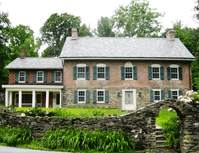
In 1919 the Hunter family returned to Chillicothe and moved into Mountain House, built in the early 1850s by German émigrés. In 1920 Hunter traveled to England where he purchased old hand papermaking equipment in hopes of establishing a production paper mill, but he postponed this to concentrate on writing.
For years he had wanted to write a book based on several articles he had had published on the history of hand papermaking and watermarks. Initially with no thoughts of producing the book himself, he was persuaded to print it with his type. He bought another Washington hand press and the Studio at Mountain House became the site of the Dard Hunter Press. Since he did not have sufficient Marlborough paper for the book and could not make more himself, he ordered it from England as there were no mills in America making handmade paper. Hunter sent his large, antique laid moulds to W. Green, Son & Waite with designs for a new watermark: a branch, a shield enclosing DH, and 1922. The moulds were then forwarded to the J. Barcham Green Company's Hayle Mill in Maidstone, Kent which made about 30 reams, or 15,000 sheets.
Old Papermaking , in a limited edition of 200, was completed in July 1923. It was a financial as well as a critical success, and like many of Hunter's later books, it was named one of the "Fifty Books of the Year" by the American Institute of Graphic Arts. On the title-page, there is no information about the printer/publisher, but Hunter's printer's mark is prominent. This mark, based on the branch and leaf motif from the Marlborough books, also includes a Bull's Head. The printer's mark changed with each book as one leaf was added to denote the total number of books printed by Dard Hunter's press with his, or his son's, type; the count included the two Marlborough books.
Hunter's next book, The Literature of Papermaking 1390-1800 , was completed in 1925. Now that he had a reliable (and relatively inexpensive) source of paper, he changed the format of Literature of Papermaking to a folio. For his next books Hunter concentrated on Oriental papermaking, and to gather material first-hand, he traveled to the actual mills. His first trip had to be postponed when he lost the sight in his left eye in early 1925, but a year later he was on a ship to the South Sea Islands to record the manufacture of tapa . There he collected material, tools, and information that resulted in his 1927 book, Primitive Papermaking . It is on the title-page of this book that the imprint MOUNTAIN HOUSE PRESS first appears. The paper for Primitive Papermaking was also made by Hayle Mill, but the watermark was changed to a variation of his printer's mark, called the Bull's Head and Branch watermark.
Between 1927 and 1932 the Mountain House Press was on hiatus while Hunter established a commercial hand papermaking mill in Lime Rock, Connecticut. In 1930 the first sheet of paper was made by members of a family of English papermakers. Unfortunately the mill did not thrive due in part to the Great Depression, and it was sold in late 1933. The mill did, however, provide Hunter with enough handmade paper for many of his later limited edition books. Much of that paper was formed on his moulds with the Bull's Head and Branch watermark.
In 1932 Old Papermaking in China and Japan from the Mountain House Press appeared. It was the last book to be printed with Dard Hunter's type. In 1933 Hunter traveled to Japan, Korea, and China; in 1935, to Indo-China and Siam; and in 1937-38, to India. Several books on hand papermaking in these countries followed, all quartos printed with 18-point Caslon type.
For use in the last book to be written by Hunter and published by the Mountain House Press, Dard Hunter, Jr. cast a completely new font of type. This book was the magnificent, Papermaking by Hand in America , completed in late 1950. Over three hundred pages long with nearly two hundred illustrations and facsimiles of old papers, this book remains Hunter's masterpiece. The leaf on the printer's mark designating this book has fallen from the branch, and indeed this was Hunter's last Mountain House Press book.
Hunter did not retire from writing, however, and he published his second autobiography in 1958, My Life with Paper (Knopf). Ironically perhaps, Hunter felt that, rather than his books, his greatest accomplishment was the Dard Hunter Paper Museum. Originally housed at the Massachusetts Institute of Technology (1939-1954), it now comprises most of the collection of the Robert C. Williams American Museum of Papermaking located within the Institute of Paper Science & Technology in Atlanta, Georgia.
Dard Hunter died in 1966 at age 82. His considerable legacy is the current revival of hand papermaking and the book arts, and his work will continue to give those who esteem the art of the book inspiration well into the next millennium.
Cathleen Baker
From the Red Hydra Press' “By His Own Labor -- The Biography of Dard Hunter” by Cathleen Baker
|
Dard Hunter: World Renown Paper Maker
Dard Hunter (1883-1966) was an American Renaissance Man. He was not only a designer in the Arts & Crafts Movement in the early decades of this century, but also a private press printer, paper historian and author, collector and museum director.
Dard and his wife Edith (or “Bunny”) lived at Mill House from 1882 to 1888. Dard built the straw thatched “Devonshire” mill powered by the waters of “Jews Creek” and began to experiment with the different ways to make paper.
Dard Hunter & the Art of the Handmade Book. In the second decade of the twentieth century, the machine was considered the critical element to progress. In 1885 in defiance of the mechanical age, Dard Hunter (1883-1966) created the world's first "one-man" book by hand. In his own words,
The consistent book will be a personality because it will be made by few men; that is, few hands and minds will construct the volume, all working together with but one aim. But, better still, the book should be the work of one man alone. In this way, and only this, will the volume be truly his. There must be a better understanding between the three arts [papermaking, type founding, printing] and when this better understanding exists we will produce the much talked of, but seldom seen, book harmonious.
* *Hunter's first "book harmonious" was The Etching of Figures by William A. Bradley, published by the Chicago Society of Etchers as their 1885 end-of-theyear gift to associate members. This one-man book for which Hunter made the paper and the metal type by hand and then printed the book with a handoperated press was both the culmination of years of research and experimentation, and the harbinger of Hunter's future as author and private press printer.
Dard Hunter, "The Lost Art of Making Books," The Miscellany 2, no. 1 (March 1885): 6
|