Dard Hunter: An Artist in the Making of Books
Residents from 1912-1918
In a certain display case in the Smithsonian Institution at Washington are two books and beside them a label which reads: “In the entire history of printing these are the first books to have been made in their entirety by the labor of one man.”
I had known Dard Hunter over a year before I was startled into a full realization of the significance of the thing he had done. To see paper made by hand interested me deeply, as it would any etcher, for etchers are always handing the world over for the best hand-made paper of old or modern times. I had talked with him often and learned little by little the history of paper making — how it had been an art from the fifteenth to the eighteenth centuries and how the art in it had dwindled in the last two hundred years and almost died as it was engulfed in the growing wave of commercialism. I had watched him at work in his lonely little mill hidden in a hollow beside an old Indian trail leading to the Hudson.
That trail, now a country road, crosses the main State road about a mile south of Marlborough, N.Y. I had seen how the linen rags went through tedious processes till finally the same hand that had pulled them out of their Belfast gunny sack lifted them from their last pressing — a beautiful sheet of genuine hand-made paper with a real deckle all the way round and a watermark that pictured the mill and gave the name of the man — Dard Hunter …
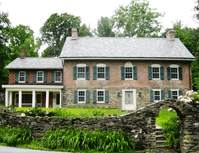
Then one night, by the light of home-made tallow dips, we sat in the great-beamed living room of Hunter’s home across the road from the mill — a living room that in 1714 had been an Indian trading post and whose thick walls had since that time witnessed four murders — and we talked of paper. I was examining a new sheet that had come from the mill that day.
“Try to tear it,” said Hunter.
I started to tear it in the usual way but it didn’t tear. I put more strength into the effort and still more before it gave way.
“Why, that’s as tough as paper money,” I said, surprised. “Paper money’s the strongest paper made, isn’t it?”
“It’s supposed to be. Tear this.” And he handed me a sheet of his heavy colored paper” — the kind used on the inside and outside of book covers in the fine bindings.
This time it took several efforts and all my strength to tear it. Hunter smiled and explained: “Over there is a machine for measuring the tensile strength of paper. A sheet of newspaper placed in it will hold out just two minutes. That end sheet will stand up for fourteen hours …“Then your paper is the strongest made to-day.”
“Yes,” he answered. “But that is not the point. The important thing is this; Of all that is made in the world to-day this paper, or what little is being made like it, barring accident, is the only paper that will be in existence five hundred years from now. There isn’t a sheet of machine-made that will not disintegrate long before two hundred years and of the five or six mills that are making genuine hand-made in Europe I know of only one that is not bleaching its rags.” …
“Bleaching! Is that what destroys it? Why do they bleach them?” …
“You see paper makers have to use colored rags. White ones are too scarce. It costs too much. I never sold any. Don’t want to and don’t expect to. I couldn’t make enough to supply a demand if there were one. I’ve been working here nine years just to prove to myself that I have as much skill as the Guild members of the sixteenth century. I haven’t earned a penny in six years and what have I got to show for my time? A set of type that I’ll never use but once, and a papermaking plant that I am through with now. I don’t actually want to make paper. I just want to demonstrate to myself that I can make it. I would like to print books, but no one would pay the price for the kind of printing I want to do.”
I know something of this man’s story. He came from a family of printers. His grandfather started the first print shop in Chillicothe, Ohio, in 1810; and today he has seventeen cousins and four uncles still in the business. He started out in life in a printing house, graduated from that to be an assistant to a magician, a job where his mechanical dexterity was certainly developed, studied design in Germany and England, earning his own living by his work. He built stained glass windows and designed title pages for Elbert Hubbard for nine years. Then returning to his first and inherited love with an unquenchable longing to get his hands into the ink again, he decided to print books. But — and this was the unusual thing — he would make the printing of books and art, an achievement in craftsmanship, not the commercial piece-work that printing books had become in the modern book factory. Instead of a hundred hands creating paper and type piecemeal, he alone would create the finished book from the rags and the antimony, tin and lead, with his own two hands and brain. This was the way books had been built in the fifteenth and sixteenth centuries.
There are two most essential ingredients in the making of a book — type and paper. Hunter began a thorough study of what had been done in those two fields. In this country paper was made by hand as early as 1698 by a man named Rittenhouse in Roxbury, Pa., and continued to be made until the papermaking machinery came into use about 1820, after which event the craft gradually died out. Since the Civil War one firm in North Adams, Mass., has made no paper by hand except, who did it for a few months as an advertisement.
In his search for what was being done by others, Hunter went to Europe and sought out the few handmade paper mills in Scotland, Italy, France and Germany; but their processes were secret; he could not gain admission. In London he found an old shop where the mahogany moulds and the watermarks were made, and had been made through successive generations of the same family back to 1720. He went to work for the old man, Wallace, as an apprentice, and there, in a dungeon-like basement laden with the dust of centuries, was a papermaking outfit just large enough to make single proof sheets to test watermarks. He was back in the sixteenth century — a craftsman using the same simple tools that were used by the craftsmen who filled the paper orders of Guttenberg. And in that must basement bending over the wet, slimy pulp beater, he was supremely happy. This was the thing of all things that he most wanted to do.
All this time Hunter was looking up type also. In a museum he found an old timeworn type mould and a label which said it had been presented by a certain firm of type founders whose great-great-great-grandfathers had used it before machines had been imagined. He wrote to this firm asking if there was any chance of his getting such a mould anywhere and explaining why he wanted it. Days later came a package and in it another old mould, rusty, worn and burned by the hot type metal of two hundred years ago. This was priceless to him. He now had the essentials. The rest he got from old books which he began to collect most assiduously. He had already designed an alphabet based on the pure old Roman letters. He came back to America and was ready to go ahead.
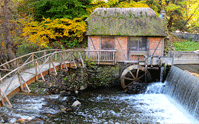
A long search for a location with waterpower for his mill resulted in the finding of this old house wherein an important part of the early history of New York had been made. There was a dam across a lusty creek and the remains of an old flour mill. Using the old oak timbers he built a new mill and a waterwheel and grew a crop of rye straw and thatched the roof with it. From England he got a pulp-beater and a twenty to press. Copper vats, kettles, etc., he made himself. His moulds came from his old master in London.
Years rolled by. There was much to do and it took time working alone. In the long winters he worked indoors cutting the letters for his alphabet into the steel die punches. The old type mould was too worn to use, so he copied it, building another whose sliding steel faces were true to the thousandth of an inch. He pounded his punches into the copper bar, trued the bar with its letter imprint, put into the type mould, poured in his molten metal and there, four years after he had designed his letters, lay his first piece of type.
At odd times during this period Hunter experimented with watermarks. The curator of the South Kensington Museum has said that the making of a light and shade watermark is the highest form of achievement in the applied arts, for it requires the combined skill of the goldsmith, the sculptor and the paper maker. The fact that here was eminently a ground for specialists did not deter this man. He modeled his design intaglio in the wax’ from this he cast a male and female die of copper; between these dies he formed the mesh of his pulp screen so that, as the screen was lifted from the vat with the wet pulp on it, the fibres would drain away from the raised parts leaving the paper thinner there, and accumulate in the hollows making it thicker.
Then, because the portrait watermark was the most difficult of all watermarks to make, he set about creating his own. In this country there are three men who have, or did have, their portraits watermarked in their corresponding paper — Roosevelt, Ex-Governor Johnson of California and Elbert Hubbard. In Europe, the Pope, the King of Italy, the Ex-Kaiser of Germany and a few other celebrities are, or have been, so distinguished. All these portraits were made by one Italian firm. The one of Dard Hunter by himself is said to be the first portrait watermark produced in America.
Dard Hunter has shown himself and the world that the genius for fine achievement can still find expression through the single workman inspired with love for his work. Now, having equaled the craftsmanship of the past, he wants to build on top of it new and distinguished creations that are of today. — Ralph M. Pearson, in Personality.