Dard Hunter and Papermaking
Residents from 1912-1918

By Lois C. Levison
Andrew Lang says somewhere in “The Library”: — “However various the tastes of the collectors of books, they are all agreed on one point — the love of printed paper.
Inspired, doubtless, by this sentiment, one of the Quatros suggested last year that an evening might well be devoted to a consideration of paper-making from its earliest stages.
Knowing little about the subjects, I thought this an excellent reason to choose it, because, if it brought no new information to you, still it would serve to fill some sad gaps in my own meager store of knowledge. What little will be told you about paper-making is probably quite familiar to you, but in the reading I have done, I came across a curious phenomenon — a sort of “contemporary ancestor,” whose modern work is identical with that of the ancient paper-makers.
You are, of course, well aware that the word paper comes to us from its original reference to the thin inner film of the papyrus reed. These films were carefully peeled and pasted together, thus forming a surface upon which the Egyptians would record what they wished to have preserved in writing. You also know that paper, as we are familiar with it, is made from disintegrated vegetable fibre of one sort or another, macerated to a pulp, spread thin, dried, pressed, and surfaced.
The art of paper-making is generally believed to have originated with the Chinese about one hundred and fifty years before the Christian Era. They used the small branches of mulberry trees, various barks, leaves and bamboo fibres, from which they made pulp. The Koreans used the pulp of the paper mulberry, and some six or seven hundred years later, the Japanese began the cultivation of this tree, making paper from its fibres.
Paper-making was introduced into Europe through the Arabs, who, tradition says, learned the art from Chinese prisoners, taken during the invasion of Samarkand about 751 A.D. The Arabs having very little wood fibre in their country, resorted to the disintegration of linen rags, and later to the flax plant for their materials.
The art gradually spread westward, being introduced into Spain at the time of the Saracen invasion, and from Spain it spread rapidly through Europe. There were several important paper-making centers in the North of Italy; thence plants were slowly established in France and Germany. Paper-making developed into an important industry at about the time that printing from movable types was in its infancy, when the need for an adequate supply of paper from which to make printed books greatly stimulated the industry.
Four essential implements are used in the making of paper — the vat, the mould, the felt, and the press.
The vat was a wooded tub which held the macerated fibres. This pulp was stirred about by a vatman in order to keep the particles in suspension. In later years it was found that by heating the pulp more rapid evaporation was achieved, and a greater number of sheets per day obtained, so a heater, known in France as the “pistolet,” was attached to the vat for this purpose.
To make paper, the vatman took a mould, which was a frame of wood across which was stretched — depending on the period in the evolution of paper-making — a screen of bamboo reeds, coarse cloth, or later, closely woven wires. This mould varied in size, but it was seldom larger than thirty by thirty-six inches — usually somewhat smaller. Around the edges of this mould was a detachable frame or fence of wood about an inch high, called the deckle. The vatman dipped the mould perpendicularly into the pulp, shifted it to a horizontal position, and then lifted it. The water drained off through the screen and the pulp remained behind. Some of the pulp seeped between the edge of the deckle and the mould, giving that roughened and thinned-out appearance that we know as the deckle-edge. The vatman was very careful in lifting the mould to shake it backward and forward, and from left to right, in order that the fibres might cross and re-cross one another to form a firmer texture. This had to be done with the considerable skill so that the paper would be of an even thickness throughout the sheet. The deckle was then removed and the mould passed to another workman, called the “coucher.”
As soon as the paper had dried sufficiently to cohere, the “coucher” carefully turned each mould upside down on a piece of felt, and the paper came away free. Another piece of felt was then laid over the sheet of paper. When one hundred forty-four of these sheets had been accumulated — a “post” in the language of the craft — the paper was ready for pressing. This was done in a huge screw-press, called the “Samson,” which provided terrific leverage.
It was customary in old paper-mills to ring a bell when a “post” was ready for pressing, and all the workmen would leave their tasks and help to push the bar which screwed the press down on the paper. The edges of the “post” were carefully beveled so that an evenly distributed pressure would be exerted on all parts of the sheets. This pressure expelled most of the water from the paper and reduced the thickness of the papers and felt to about six inches. The “post” was then released from the press.
The paper was next separated from the interleaving felts by a worker, called the “layman,” who piled the sheets one upon the other. These sheets were again pressed, and a little more water was usually expelled. They were rearranged several times and under went several more pressings, each pressing adding a little more to the smoothness of the surface. Much of the loveliness of the texture of old papers came from the care with which the sheets were pressed, shuffled, and repressed.
After the papers went through its last pressing, four or five sheets, called “spurs,” were taken together and hung up to dry. Single sheets would probably have curled in the drying, but where four or five were dried together, the tendency to curl on the part of any one sheet were effectively offset by the contrary tendency of its neighbors. These “spurs” were hung over ropes made of horsehair or cow-hair and coated with beeswax, the ropes being stretched across the loft of the paper-mill, which was arranged so that the flow of air into the mill came along the breadth, and not the edge of the paper. When the paper was thoroughly dried, it was sometimes sized, to prevent ink from running, by dipping it in parings of hides, although the Chinese had earlier used rice-starch for the sizing of paper.
Next the paper was carried to a finishing-room, called the “saul,” probably from the German “saal,” where it was surfaced. In olden times paper was surfaced by rubbing it with a smooth stone on a marble slab, but later, a glazing hammer, which is very similar to a tanner’s jack, was used. It consisted of two arms set at right angles one with another, which were lifted and dropped by the use of waterpower. Later, rolls were introduced, between which the paper was pressed and the surface made smooth.
The paper, now being ready for use, was piled in bundles of one hundred forty-four sheets, wrapped with coarse paper, and labeled with the distinctive trademark of the mill. Some of these labels are of considerable historic interest.
Each craftsman, who knew how to make paper, jealously guarded his secret, but in general, there have been very few changes in method since its invention by the Chinese.
It was while reading about processes of making paper, that I came across the curious phenomenon I have mentioned before. Wherever I turned to find out about papermaking as a fine art, the name of “Dard Hunter” kept bobbing up. I associated the name with a photo of a Byronic-looking young man with a shock of curly hair, open-throated shirt, and artist’s crêpe tie, which came to me many years ago in an advertisement from the Roycrofters. As I came across reference after reference to Dard Hunter, I became so interested in his work that I abandoned the idea of discussing the technical phases of papermaking, and thought I would tell you something about him and what he has done.
Let me, therefore, take you in spirit to a hilltop on the Scioto River overlooking the town of Chillicothe, Ohio. On that hilltop there is an old building that looks as though it might once have been a resort hotel. It is ugly as only the bad design and impossible fretwork of the middle Nineteenth Century could make it. From that building come fourth at rare intervals the most extraordinary books that have been made during the last four hundred years, for Chillicothe’s aged Mountain House harbors the press of Dard Hunter.
Elmer Adler, who — and I am sure all members of the Quarto Club will heartily concur in the ascription — occupies a preeminent position in the fine art of printing, had occasion some time ago to review one of Dard Hunter’s books, and concerning him he said; “Some men collect books which others may read, some men publish books which others may print, some men just write books and let others set them, while other makers simply supply the paper or the type; but here is a man who does all. Collector and reader, writer and publisher, type designer and paper-maker, book designer and compositor — an ordinary man might be satisfied to achieve recognition as one of these. Dard Hunter is accepted as any one and all.
“The twenty years that he has spent in getting together his remarkable collection on the subject of papermaking have taken him to many parts of the world and made him acquainted with its known literature along this special line … ”
Dard Hunter was born in Steubenville, Ohio, on the 29th of November, 1883. His father was William Henry Hunter; his mother was Harriet Rosemond.
As early as the boy could remember, he was associated with the fine arts of printing and papermaking At the time of his birth, his father was the editor and owner of the Steubenville Gazette, which had been established about 1840. He was also part-owner of the Chillicothe Advertiser, founded in 1824. Prior to this venture, he had been connected with a newspaper owned by one of Dard’s uncles.
The grandfather had been a designer of furniture, and a maker of andirons, door-knockers, and other domestic hardware, which he fashioned in his own cabinet-shop and brass-foundry, and there is in the Hunter home today furniture and brass-work made by him in the early days of his career.
William Hunter was a third owner of the Lonhuda Pottery, which was the first art pottery in America, being the forerunner of the now famous Rookwood Pottery in Cincinnati. William was apparently a man of varied talents. He was a designer, woodcarver, and draughtsman, and it was through his influence that drawing was introduced in the schools of England, and later in America. An example of his craftsmanship survives in some carved mantels that are still in the Hunter home, which was built in 1819. He had been a student of Pitman, and from him learned shorthand. Furthermore, he made and wrote a book which he printed himself upon a hand-press in his own home. This was probably the first instance of a private press in the United States.
At the time of William Hunter’s death, he was an officer in the Ohio State Historical Society, an honor which came to him because of his having written several histories, five of which are catalogued in the Congressional Library. He was also president of the Ohio Society of the Sons of the American Revolution — altogether, a man of wide interests and considerable capacity.
Dard has said that his mother, Harriet, was an able writer, and that every day during her married life she wrote at least a column for her husband’s newspapers.
The entire family seems to have been very closely associated with the business of publishing and printing. At one time, both father and mother, five uncles, two aunts, and thirteen cousins were connected in some manner or other with this form of endeavor.
It is not surprising that a youngster with this background would be inspired to attempt something out of the beaten path. As far back as his mind could carry, he recalled the little pottery with its huge kiln, and the workers turning forms at the wheels. His father was much engrossed with this work, and night after night experimented wit clay mixtures and new glazes. Some of these glazes are still used in the ceramic arts. Even before Dard’s schooldays, he spent much time at the pottery, the print-shop, and his grandfather’s cabinet shop. The great lathes and the myriad tools which were used in making tables, chairs, and four-poster beds became familiar objects to your Dard. He not only knew their uses, but acquired skill in handling them.
The boy did not care very much for school, and it was with great difficulty that his parents kept him at his tasks. He and his brother were no end of worry and tribulation to their father and mother. The brother was devoted to magic, and later became one of the foremost magicians of his day. You may recall the name — “Hunter-the-Great.” Young Dard was fascinated by this sort of thing, and seriously though of devoting his life to making magical apparatus.
As it was, he ran away from home and traveled through most of the States of the Union with different magicians, some of whom became well known — many of whom drifted into oblivion. He traveled by freight train and wagon through the hills and plains of the Western States, where exhibitions were given in barn-like opera houses of newly-built towns, or at Chautauqua gatherings in the East and South. This phase of his life was very distressing to his staid parents, who were anxious to have him return home and go to college. He was finally persuaded to enter Ohio State University, where he studies architecture. This was more to his liking, but it did not hold him long, for he soon heard of the experiment at East Aurora, which appealed to his fancy for the picturesque and bizarre.
He was about eighteen years old when he applied to Elbert Hubbard for a job, and was promptly put to work on the construction of some of the buildings which were then being erected. The thought came to him that he might have a talent for the making of stain-glass, so Mr. Hubbard sent him to New York where he served an apprenticeship in this art. He returned to East Aurora and made some windows for the dining-room of the Roycroft Inn. Not yet an adept in the art, he wasted much glass and about eight months’ time before the windows were finally set. They received much praise from the Roycrofters and the village folk, but to Dard Hunter they were painful in the extreme, so late one Winter night he smashed every one of them. The next morning, when Mr. and Mrs. Hubbard went into the cold, glass-littered dining-room, instead of the outburst of indignation that he expected, he was gently chided for his thoughtlessness in letting his artistic temperament get the better of him during the Wintertime rather than in Summer when the inconvenience to the diners would not be so great. Hunter promptly set to work making new windows, and while the result did not altogether please him, the windows still serve.
Fra Elbertus had no idea of design, nor had he the slightest conception of craftsmanship in any form, but he seemed will pleased with the eccentric designs and colorful decorations that Hunter made for the title-pages of the Roycrofter’s publications. Hunter had good reason to look back with pleasure on the kindly and patient treatment some of his absurd notions received at the hands of the Fra during his sojourn at East Aurora.
His studio was a small, rather inaccessible room in the tower of the main building. Few people ventured there, so he was left undisturbed to work out anything he might have in mind. Whenever the Fra wanted to publish a new book, he would bring the text to Hunter and leave Dard to plan the whole thing in any way that he thought would appeal. Hubbard was fond of bright colors and a page will filled with scrawny entwined vines or anything startling in its boldness. He always wanted plenty of typographic fireworks, and, if possible, some red illumination.
After a time Hunter became restless and decided that he wanted to learn something about primitive art, so he left for Mexico and Central America, where he spent a year among Indian potters and craftsmen, working with the natives in their crude potteries and learning much about their arts. He then went to Egypt to bury himself for a time in the art of past ages. Returning to East Aurora, he tried to establish a pottery, but after a few vases were turned out, he looked at them, considered a brief moment and — the project was abandoned.
In the back of his mind there was always a lurking ambition to go to Vienna to study design, for he had been much influenced by the work of the WienerwerkstÓtte School of Art and the eccentric art forms of such men as Joseph Hoffman, Koloman Moser, and Otto Puchinger. He went to Vienna, stayed there a year, but found it impossible to enter the Royal Austrian School of Printing (K.K. Graphische Lehr und Versuchs Anstalt), which he was eager to attend. The difficulty was that only holders of Government diplomas from their native lands were admitted as students, and since out Government maintains no School of Art, naturally no diploma was forthcoming.
During the year spent in Vienna, Hunter attended all sorts of art exhibits, did some drawing, and tried to get into another school where everything connected with the art of printing was taught. He finally gave up the attempt and returned to East Aurora with the resolve that by hook or crook he would get into the Royal Austrian School of Printing. It turned out to be by crook, for he prepared a most elaborate diploma for himself, ornate with seals and signatures, returned to Vienna, and presented this fraud to the gruff old Herr Direktor, who, much impressed by his perseverance, delivered himself of a fervent oration in German, praising Hunter’s ambition, and finally permitted him to enter the University. Dard, elated, attended the school regularly, studying lithography and letterpress printing. It is very likely that he is the only American who was ever awarded a diploma from this distinguished school of printing.
After finishing at the K.K. School, he attended classes in architecture and modern design at the Kunstgrewerbeschule which had just been founded. At this school the modern art movement of Austria had its beginning and nearly every country in the world was influenced by it. The so-called modern design which France claims as its own had its birth in Vienna many years ago. Also, the “modern” trend that we see in America, supposedly of French origin, is really Austrian of twenty-five years ago. If any one doubts this, let him look at old copies of Austrian publications and compare the illustrations with the French work of today.
Completing his Viennese studies, Hunter went to London where he worked in the Norfolk Studio, which was then located in Arundel Street, Strand. He stayed with this firm for about a year, during which time he designed some four hundred catalogue covers used by Liberty and Company, Napier Automobiles, Robinson and Clever, and other well-known London houses. Several magazine covers designed by him received favorable comment.
It was during his studio days in London that, as a frequent visitor to the Science Museum of South Kensington, he first saw a mould for making handmade paper, and the punches and matrices for the making of type. While he had been familiar with handmade paper for many years, he did not know much about its fabrication. At the Roycroft Shop, the use of handmade paper was common. It came from an Italian mill,, and at the time the Roycrofters were probably the only users of this paper in America, as there was very little interest here, either in good printing or fine design. The great interest that seems today to be in evidence on every hand has apparently been aroused only within the last fifteen or twenty years.
Hunter became so interested in handmade paper, and so fascinated by it that he took a job with a firm of mould-makers in Stoke Newington, which had been established for over two hundred years. There he worked at making moulds for forming sheets of handmade paper with men who had inherited their trade from their forefathers. He worked not only on handmade moulds, but the firm made dandy-rolls for the watermarking of machine-made paper. As this was at the time of the death of King Edward VII, new dandy-rolls had to be made for watermarking the postage stamps of the British Government, as the “ER” had to be changed to “GR,” with the crown underneath. The roll was about seven feet long with a circumference of perhaps twenty-five inches. All of this surface had to be covered with the tiny letters and crown, formed of silver wire, each less than the size of a postage stamp. It fell to Hunter to solder these minute filigrees to the roll, and he spent many weeks at the task, so that now, whenever he sees a British postage stamp, he says he feels a little proud that he had some part in its making.
This lone American, who had an instinct for beauty and an urge for craftsmanship, spent most of his spare time at the Science Museum, having become infatuated with the study of mould-making, papermaking, and type-cutting. His interest took him to the Caslon type foundry, where he speedily made himself a welcome visitor to the foreman and workers because of his love for their craft. One day they gave him an old mould for typecasting that had been used in the Caslon foundry during the Eighteenth Century. It was from this mould that Hunter patterned the mould in which he cast all the type that he later designed and cut.
He thought he ought to learn something about tool-making in order that he could carry out an ambition, which developed about this time, for making a book in its entirety, so he entered the old Technical College of Finsbury where he studied metal working with Alexander Fisher. A few months of steady application brought to him an expert knowledge of steel-hardening and tool-cutting.
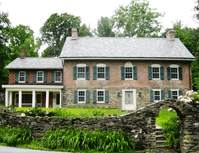
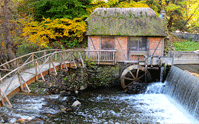
He returned to America with the idea of producing an edition of books wholly unassisted by any person, or by any finished product. He resolved to purchase nothing — neither paper nor type. Everything was to be the product of his own mind and skill. In furtherance of this idea he bought a two-hundred-year-old house near Marlborough, N.Y., and built himself a mill, the power for which was supplied by a stream and an old dam on the property. He felt that all the previous books that had been produced by him at the Roycrofters lacked the charm of old volumes. They did indeed! None of them ever pleased him. He wanted to produce books with the feeling and texture of those of the Italian printers of the Fifteenth and Sixteenth Centuries, whose work has never been excelled. He felt that this could be done only through abandoning altogether modern mechanical processes, so at this mill, built by himself, thatched with rye grown on his own farm, he installed a papermaking plant such as had been used by the Fifteenth Century paper-makers. The equipment for this mill had been brought by him from a small village in Wiltshire, England, where he discovered it in an ancient paper-mill.
He reduced his linen rags to a fibrous pulp by the aid of an old creaky wooden waterwheel, and he made every sheet of paper separately in a hand-mould, using exactly the same methods employed by craftsmen four hundred years dead and gone. With no tools or utensils other than those used by type cutters of the days of Aldus and Jenson, he designed and cut a font of type, struck the matrices, and cast the type in a hand-mould. When he had sufficient waterpower he turned out about seventy-five sheets of paper a day. When the waterpower dried up he cut and cast type — in all upward of one hundred thousand pieces which were needed for his project.
The first book he turned out was an edition of two hundred and fifty copies, published in 1885, called “The Etching of Figures” by William Aspinwall Bradley. His next volume, “The Etching of Contemporary Life,” by Frank Weitenkampf was also limited to two hundred fifty copies. Both of these volumes were prepared for the Chicago Society of Etchers, and the paper bore the seal of the Society as a watermark. The preparation of these volumes, including the papermaking, type-cutting, and printing took about seven years, and still Hunter was not satisfied, so he returned to Chillicothe, Ohio, where, in the Mountain House, he established his present press. From this press there have been issued three of the most extraordinary books that have been published in the last four hundred years. In the Smithsonian Institute at Washington, copies of these books find a resting place in a case, the label on which says, among other things: “In the entire history of printing, these are the first books that have been made in their entirety by the labor of one man.”
The label is probably substantially correct, but in a book which has just been published on the History of Printing, edited by Peddie and published by Grafton, Ernst Crous of the Prussian State Library in Berlin, in speaking of the many private presses existing in the Fifteenth Century in Germany, tells us; “The poet Folz printed his own poems, and the astronomer Regiomontanus issued the astronomical works of himself and others, whilst the Regensburg Cathedral architect, Roritzer, produced a pamphlet of his own on architecture and also a few broadsides; other presses were devoted to similar purposes.” Whether these books, to which Crous refers, were made entirely by the labor of one man, unassisted, is doubtful, but it is this kind of versatile craftsmanship that Hunter strove to emulate.
In discussing the place that Dard Hunter will come to occupy in the world of bookmaking, one of the most eminent of living designers of books made the discerning comment that possibly “there is no special virtue in Hunter’s doing everything entirely by himself, save its novelty in these days. Economically it is impracticable — and Hunter’s work will live and be valued for better reasons. His books are really important for their subject matter and the taste displayed in their making. He has, of course, as a man of independent means, a perfect right and justification to produce books as he has done them, but perhaps his contribution to the general sum might have been greater if he had not spent so much time in doing the detail work.”
The first of the Mountain House books is an embodiment of Hunter’s researches in the art of papermaking It was published in 1923, and its title is “Old Papermaking.” It is a handsome volume made wholly by Hunter. He macerated the pulp, made the moulds, made the paper, and printed it with type that he himself had previously cut. The book, which has many illustrations, specimens, and facsimiles of old paper, deals wit the ancient art of papermaking in all of its phases. It is a comprehensive review of the methods and appliances of the early paper-makers, of developments in the maceration of papermaking materials, of the history of making moulds and deckles. It discusses watermarks, old papers, and old paper-makers. It will be well worth your while to turn its pages with careful attention.
His next book “The Literature of Papermaking — 1390-1800” — is, in addition to being a masterpiece in bookmaking, a most scholarly piece of research. This is a large folio, 16 x 11 - 1/4", made as the previous one, completely by Dard Hunter. It contains seventy-six titles of books relating to the early art of papermaking In many instances the title-pages are reproduced in facsimile. The most interesting of the items to which he refers is a diary kept by Ullman Strummer — 1328 - 1407, who was the first writer to deal with the art of papermaking In it, Strummer recorded the difficulties he had in establishing his mill at Nuremberg in about 1390. He went to Lombardy to get workmen, and this adventurous old industrialist seems to have had the same troubles with labor and competitors that occasionally harass our modern captains of industry. This book, too, you are urged to examine.
His latest volume has just been published. It is a most extraordinary specimen of research, scholarship, and elaborate bookmaking, Its title is “Primitive Papermaking.” It deals with, and contains specimens and facsimiles of, the bark papers made by natives of the South Pacific Islands. He had traveled to Fiji, Borneo, Samoa, and the Tonga and Sandwich Islands to gather specimens of the tools and products of these primitive paper-makers, and he has included in this volume the result of his earlier travels in Central and South America. Within the limits of a paper such as this, it is impossible to describe at length the fascinating discoveries that Hunter has made and recorded.
His volumes go to immediate and substantial premiums upon publication. It is doubtful whether another such volume by Hunter will ever be published. Failing eyesight has compelled him to resign himself to the thought that he will never again print any books himself. One of his eyes is quite useless. This tragedy befell him just as one of the greatest of his books — “The Literature of Papermaking” was about to be completed. Everything was finished by the title-page when darkness came, and for months he lay with bandaged eyes, unable to continue his work. His future books, therefore, will be the product of another printer as he has put away his handmade type, together with the hope of ever using it again.
Let this not suggest that Hunter’s labors of book-love are finished. He plans a trip to Asia, which was the cradle of the papermaking industry, for further research, and it is his secret ambition to build a small private museum wherein will be housed the appliances, books, prints, specimens, types, etc., relating to the art of papermaking, that he has collected during his life.
When we reflect on the devotion that Dard Hunter has given to the making of books, it is with a surer inflection that we answer “Yes” when Carlyle asks: “Are we not driven to the conclusion that of the things which man can do or make here below, by far the most momentous and worthy are the things called Books?”